
Resilience under complexity
Research, test, fail, fix, document, try again. The reflexes that separate working engineers from people who took a course.
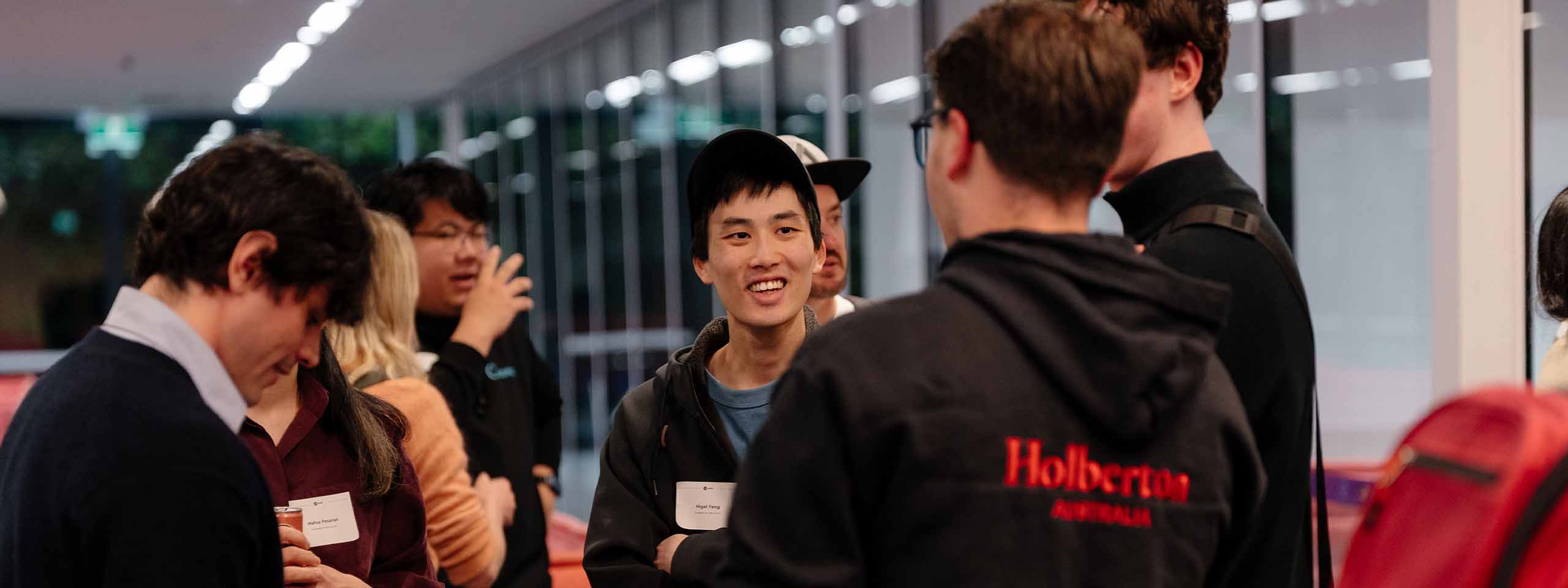
Most tech training ends with a certificate. Holberton takes you further: a FEDE European Bachelor at EQF Level 6, designed to give your skills academic weight and international readability.
You graduate with more than proof of attendance. You leave with a recognised qualification, real engineering experience, and the practical skills employers are actively looking for.
Three intensive periods. Each builds on the last.
Period 1 · Engineering foundations
From your first line of C to your first deployed pipeline.
Master the foundations every working engineer is expected to know — the command line, version control, low-level programming, and the mental model of how a computer actually runs your code.
_printf
Reimplement C's printf from scratch, in pairs.
Shell
Build your own Unix shell that executes commands and pipes.
AirBnB clone (console)
Command-line storage engine and object model.
Period 1 · Engineering foundations
Design and build secure, end-to-end web applications.
Architect software the way a real engineering team would. Model the system, build the backend, secure the data, and serve it through a working web client.
AirBnB clone (web)
Full-stack rebuild: API, database, authentication, frontend.
HBnB Evolution
Architect and document a layered system with UML before writing code.
Period 1 · Engineering foundations
Ship software that survives contact with production.
Take the leap from 'it works on my machine' to 'it runs reliably for thousands of users.' Containers, networking, deployment, and the operational thinking that makes software resilient.
Pagination engine
Deletion-resilient pagination for production-scale datasets.
Containerized multi-tier app
Reverse proxy, load-balanced services, full Compose stack.
End-of-period portfolio
Documented, deployed, and presented to a jury.
Period 2 · Machine learning and AI
The math, the tools, and the AI workflow that underpin every model.
Build the engineering muscle that machine learning sits on top of. Numerical computation, statistics, and structured AI-assisted workflows that compound your productivity.
Vector & matrix engine
Reimplement core linear algebra operations from scratch.
Probability distributions library
Build PDFs, CDFs, and samplers without scipy.
Architecture blueprint
Compare monolith and microservices designs for the same product.
Period 2 · Machine learning and AI
Design, train, and deploy modern neural networks.
Move from foundational ML into the deep learning systems that power production AI. CNNs, transfer learning, generative models, and the optimization techniques that make them work.
Image classifier
CNN trained end-to-end on a real-world dataset.
Object detector
Decode predictions, apply non-max suppression, evaluate with mAP.
GAN training pipeline
Stabilize adversarial training and generate synthetic samples.
Period 2 · Machine learning and AI
Language, decisions, and the European credential.
Bring AI into language and behavior. Build NLP systems and reinforcement learning agents — and earn the European credentials that make this a recognized bachelor.
QA assistant
Console chatbot powered by a pretrained transformer.
DQN agent
Train a deep reinforcement learning agent to solve a control task.
Data pipeline
End-to-end ingestion from API to ML-ready dataset.
Period 3 · Mastery and portfolio
The algorithms and data structures that come up in every senior interview.
Sharpen the algorithmic thinking that separates a junior who can ship from a junior who gets hired. Big-O reasoning, advanced data structures, and the discipline to deliver under constraints.
Advanced data structures
Build AVL trees, heaps, and skip lists in C.
Algorithmic challenge set
Solve interview-grade problems under timed constraints.
Mock technical interview
Defend two random projects orally to a panel.
Period 3 · Mastery and portfolio
Conceive, build, defend — your end-to-end AI MVP.
The capstone. Turn a loose idea into a working AI product, deployed and documented. Defend it to a jury. This is the project that goes on your CV and into every job interview after graduation.
AI MVP capstone
A real, deployed AI product of your choosing, defended to a jury.
Period 3 · Mastery and portfolio
From graduate to hire.
The bridge between the bachelor and your first role. Workplace practice, intercultural management, advanced language proficiency — and the professional habits employers screen for.
Language proficiency exam (B1)
Written and oral, in your chosen European language.
Intercultural management assessment
Online MCQ on the FEDE reference framework.
Continuous professional review
80%+ professional score across the period.
Software engineering is fast-paced, demanding, and constantly evolving. We train you for that reality from day one — not after.
Research, test, fail, fix, document, try again. The reflexes that separate working engineers from people who took a course.
You learn to mobilize resources, structure your approach, ask for help effectively, and progress without waiting for a lecture.
Working with constraints. Delivering outcomes. Maintaining quality. Communicating technical choices. The job, not the simulation.
Exposure to varied problems and contexts. You learn to evolve with tools and methods, not depend on a single technology.
Roles our graduates apply for:

We accept students through two routes. Both lead to the same European Bachelor.
Choose the one that fits your background.
Applicant with HSC, Baccalauréat, or equivalent minimum
Applicant without HSC or Baccalauréat
Tell us a bit about you. We respond within 48 hours.
We typically respond within 48 hours. Or call us directly: +230 5255 0390.
Yes. All instruction, projects, and materials are in English. We require a B2 minimum English level (C1 is comfortable) — this prepares you for the international tech industry, where English is the working language.
Yes. The degree is awarded by FEDE (Fédération pour l'Éducation en Europe), positioned at EQF Level 6 and internationally recognized. We can provide formal documentation on request.
Different model. Local universities focus on lectures, exams, and theory across three or four years. Holberton focuses on projects, peer collaboration, and shipping real software across two intensive years. The credential is European, the degree is at the same EQF level (Level 6), and the practical experience is incomparable.
Two paths: enter the workforce as a junior engineer (most graduates worldwide), or continue to a Master's program in Europe or Mauritius using the 180 ECTS earned.
Five days a week on campus, 8:30 to 15:00 — project work, peer collaboration, and code review. After campus, students continue building independently. The program is full-time and intensive.
Our campus is at 17 Lislet Geoffroy Street in Port Louis. Modern facilities built for project-based learning. We welcome on-site visits — book one through our contact form.
Most Holberton students don't, when they start. The Bachelor is built for committed beginners as much as for experienced builders. What matters is curiosity and the willingness to build.
Apply any time. We respond within 48 hours, then schedule the motivation interview (and entry test, if applicable) within 1–2 weeks. From application to enrollment is typically 3–4 weeks. Cohort start dates are published on the application form.